
 Facebook
 X
 Pinterest
 Copy Link
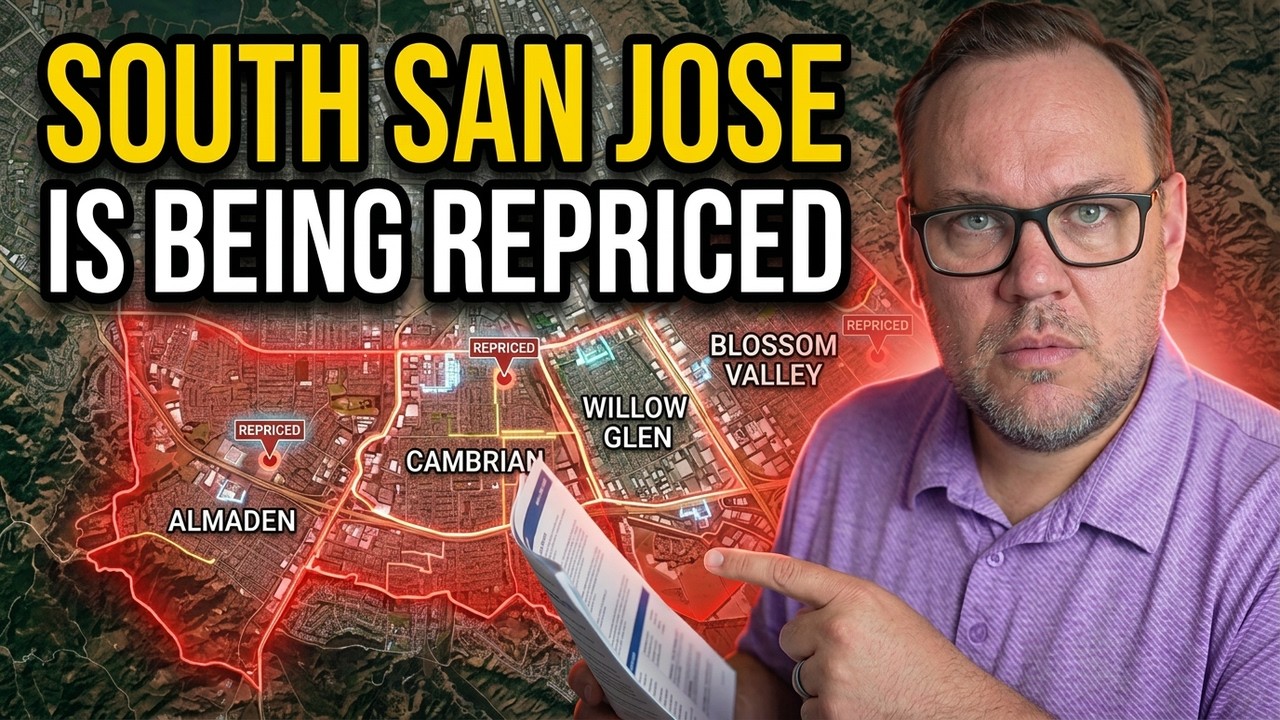
The short answer: South San Jose home values are being repriced by six forces at once: SB 79’s higher building limits near transit, the light rail link to BART, approved housing at the Blossom Hill and Branham stations, infill in Willow Glen and Cambrian, a protected Coyote Valley, and a grid built for growth. Together they make single-family lots inside South San Jose harder to replace, and that changes both value and timing.
South San Jose is about to be repriced. Not because of one new project, one freeway, or one tech campus. It’s because of a gap between what is about to get built around here and what is allowed to stay a single-family home. Almost nobody pricing houses right now is paying attention to it.
I grew up in Almaden and went to Leland. I have three generations before me in this valley, and they were here before it was called Silicon Valley. I’ve lived in Los Altos, Almaden, downtown San Jose, Blossom Valley, and Gilroy. If you own in Almaden, Cambrian, Willow Glen, Blossom Valley, Santa Teresa, or Evergreen, these six changes affect your house more than any quarterly market report.
I walked through all six on camera in May 2026. This written version adds what has changed since.
Why are South San Jose home values about to change?
If you bought in South San Jose between 1985 and 2018, you bought into a system. A certain kind of street, a certain kind of zoning, a certain commute. That system is being rewritten right now. Some of it in Sacramento, some of it a few miles from your front door.
Here’s the takeaway I want you to keep: the highest and best use of your land over the next ten years is probably not what it was over the last ten. That changes value. It changes timing. And it changes what you should do with the house, even if you have zero plans to move.
1. SB 79 raised the legal ceiling near transit
Governor Newsom signed SB 79 on October 10, 2025, and it took effect on July 1, 2026. In plain English: if your land sits within a half mile of a qualifying transit stop, the state now allows far more housing on it than city zoning used to permit. The closer to the station, the higher the limit.
| Distance from the station | Light rail stop (Tier 2) | BART stop (Tier 1) |
|---|---|---|
| Within 200 feet of a station entrance | 85 ft, 140 homes per acre | 95 ft, 160 homes per acre |
| Within 1/4 mile | 65 ft, 100 homes per acre | 75 ft, 120 homes per acre |
| 1/4 to 1/2 mile | 55 ft, 80 homes per acre | 65 ft, 100 homes per acre |
Maximums under Gov. Code § 65912.157, as summarized by ABAG in April 2026. Cities can adopt local alternatives that meet state rules.
This does not mean every lot becomes a seven-story building overnight. It absolutely does not mean the city is going to bulldoze your cul-de-sac. What it means is that the legal ceiling on what can be built near transit just went up. The legal ceiling is the thing that prices land.
South San Jose has more qualifying stops than most owners realize. Draw a half-mile circle around the light rail stations at Blossom Hill, Branham, and along Capitol Expressway, and you start touching parts of Cambrian, Willow Glen, and Blossom Valley. The single-family homes inside those circles just got more valuable as land. Not necessarily as houses, because the legal use of that land has changed.
Worth knowing: the final law keys off rail and bus rapid transit stops. A regular bus line, even a frequent one, doesn’t qualify on its own. If you’re near a light rail station, this applies to you. You can read the state’s overview on the California HCD SB 79 page.
2. Light rail is finally getting a direct link to BART
For 20 years, the joke around here was that VTA would get to BART eventually. Eventually has a date now. The Eastridge to BART Regional Connector is a 2.4-mile elevated light rail extension along Capitol Expressway, from the Alum Rock station to the Eastridge Transit Center, with riders connecting to BART at Milpitas.
Update, November 2026: VTA reported at least 90% of the elevated structure complete in September 2026 and expects the project to be fully finished in early 2028.
The thing that held South San Jose back for two decades isn’t the houses. It’s the commute. Once you can step onto light rail in East San Jose and reach Oakland or San Francisco without a car, the commute premium that pulled buyers north to Sunnyvale and Mountain View starts to compress. It won’t make South San Jose equal to Palo Alto. It will narrow the gap. In my view, narrowing it by even 5% to 8% is enormous in this market.
Now stack that on SB 79. The law keys off transit stops, and this project adds new ones. New transit makes land more valuable, and the law makes it legal to build more on that land. That’s compounding.
3. Housing is already approved next to the stations
This isn’t theoretical. Here’s what is already moving next to South San Jose light rail.
Blossom Hill Station, 605 Blossom Hill Road
The City Council approved the Blossom Hill Station mixed-use project on August 9, 2022. It allows up to 328 homes in two six-story buildings, 239 market-rate and 89 affordable, plus about 22,600 square feet of ground-floor commercial space. As of May 2026, the design was still being adjusted, with the affordable building expected to break ground first.
Branham Station
About a mile and a half away, VTA is planning 45 townhomes on roughly 3 acres of the Park and Ride lot at Branham Lane and Narvaez Avenue. They’re three- and four-bedroom homes, sold as affordable homeownership on a long-term ground lease, with Charities Housing as the developer. VTA calls it a landmark homeownership project. It’s still in planning.
What happens when 300 homes land near you
When a project this size lands in a neighborhood, retail tends to follow: coffee, restaurants, gyms, services. The comp set for nearby single-family homes changes too. You’re no longer only selling to someone who wanted a tract home in Blossom Valley. You’re selling to a renter nearby who got promoted and wants a yard within a short walk of where they live now. That’s how repricing actually happens. Not in headlines. In comps.
4. Willow Glen and Cambrian are getting denser from the inside
A lot of South San Jose owners assume the density push stops at the freeway. It doesn’t.
Willow Glen is quietly getting denser. Not through towers. Through ADUs, small infill apartment buildings on Lincoln Avenue, and a slow shift in what the city will approve on a corner lot. Lot splits have been slow to produce homes here, but the legal path is in place. The character of the neighborhood isn’t changing. The value of each lot is.
The bigger story is Cambrian Park Plaza at Camden and Union. The city’s project page lays out the plan for the 18-acre site:
- 305 apartments over about 51,000 square feet of retail and restaurants
- 48 single-family homes with 27 ADUs, plus 25 townhomes
- A 229-room hotel
- Senior living with 110 assisted living beds and 50 independent units
- 4 acres of open space
Here’s the honest part. This project has been stuck. As of May 2026, the current approvals had a time limit, and the developer was working to extend them and build the housing first. That tells me the owner is still committed.
Cambrian has been the quiet middle child of South San Jose for a long time. Not as known as Willow Glen, not as established as Almaden. But it sits in the geographic center of everything: the transit corridors, the new construction, the major roads. When Cambrian Park Plaza moves, Cambrian becomes a real hub instead of a pass-through. If you own in Cambrian, this is your appreciation story for the next five-plus years. Not because of speculation. Because of geography.
5. Coyote Valley is off the table for big development
This is the one almost nobody talks about correctly. In November 2021, the San Jose City Council voted unanimously to switch land in North Coyote Valley from industrial designations to farming and open space. Before that, the city and its partners had already bought and protected hundreds of acres there. The open land between San Jose and Morgan Hill is not coming on the market as large-scale housing or office space in any planning horizon that matters.
It sounds like a lifestyle story. It’s a pricing story. The Bay Area is short hundreds of thousands of homes. The state passed laws to force density. The transit is being built. Demand isn’t going away. And the one big piece of land everyone assumed would absorb the overflow is permanently off the table.
That means new housing has to be built inside the existing footprint: Almaden, Cambrian, Willow Glen, Blossom Valley, Santa Teresa, Evergreen. There’s no escape valve. Single-family lots inside South San Jose become harder and harder to replace. That’s the textbook definition of a repricing event.
6. The power grid is being upgraded for growth
This one almost never makes it into a real estate conversation. In March 2023, the California ISO picked LS Power to build two new high-voltage transmission projects bringing power into the San Jose area. Local grid upgrades are happening across the South Bay too.
It isn’t exciting, but density doesn’t work without grid capacity. Multi-story buildings, EV chargers, heat pumps, and induction stoves pull far more power than the 1970s tract-home infrastructure was built for. Where the grid gets upgraded tells you where the state and utilities expect growth. If your block recently had substation or transformer work, I’d read that as a signal.
Your South San Jose home is really three assets
Put it all together and you own three different things at the same time. Most people only think about the first one.
| Asset | What it is | What’s changing |
|---|---|---|
| The house | The structure: kitchen, roof, floor plan | The least interesting part, and what most valuations focus on |
| The land | The lot your home sits on | SB 79 and SB 9 may have changed its legal use, and its value with it |
| The location | A spot inside a fixed footprint | Coyote Valley is closed, density is pushed inward, and transit is being built |
So when I tell a client the highest and best use of their land over the next ten years probably isn’t what it was over the last ten, this is what I mean. The house you bought in 1998 is, in 2026, a piece of constrained supply on land the state may have just up-zoned. That’s a very different asset than what you bought.
What I’d do if I owned in South San Jose right now
If you’ve been thinking about selling: the question isn’t whether the market is up or down this quarter. It’s whether your block is inside or outside one of those half-mile circles. That changes your timing.
If you’re staying: this might be the year to look seriously at an ADU, a lot split, or a remodel aimed at where the neighborhood is going. The legal options just opened up.
If you plan to pass the house to the next generation: Proposition 19 and SB 79 together create real planning opportunities. It’s worth a conversation with me and your tax advisor before anyone makes a move.
Most owners are still pricing their house off what a neighbor sold for in 2022. That isn’t the right comp anymore. If you want to see how your home’s number looks today, I’d start with what lot size means for value in Almaden Valley and why low inventory keeps pressure on Silicon Valley prices.
Frequently Asked Questions
Does SB 79 mean my neighbor can build a seven-story building?
Only if the lot is close enough to a qualifying station and the project pencils out. Near a light rail stop, the state limit runs from 85 feet right by a station entrance down to 55 feet between a quarter and half mile away. Most single-family streets won’t see towers soon, but the land underneath them is worth more because the option exists.
Which parts of South San Jose are inside SB 79 transit zones?
Land within a half mile of qualifying light rail stations, including Blossom Hill, Branham, and the Capitol Expressway corridor. That reaches into parts of Cambrian, Willow Glen, and Blossom Valley. The regional planning agency publishes the official station map, and I can check a specific address for you.
When will the Eastridge to BART light rail extension open?
VTA expects the 2.4-mile extension to be fully complete in early 2028. As of September 2026, at least 90% of the elevated structure was finished.
Is Coyote Valley going to be developed?
Not for large-scale housing or office. San Jose and its partners have bought and protected land in North Coyote Valley, and in November 2021 the City Council voted unanimously to switch land there from industrial to farming and open space.
Does a zoning change raise my property taxes?
No. Under Proposition 13, your assessed value is based on your purchase price plus a capped annual increase. A zoning change by itself doesn’t trigger a reassessment. New construction, like an ADU, is assessed when it’s added.
What’s happening with Cambrian Park Plaza?
The plan for the 18-acre site at Camden and Union includes 305 apartments, 48 single-family homes with 27 ADUs, 25 townhomes, a 229-room hotel, senior living, and retail. As of May 2026, the developer was working to extend its approvals and build the housing first.
Should I sell my South San Jose home now or wait?
It depends on where your block sits. A home inside a transit zone may gain value as land, which can favor waiting or adding an ADU. A home outside one competes more on condition and price. I’ll walk you through your specific street before you decide.
Want to know what this means for your street?
Not a market report. Not a brochure. An actual sit-down with the data on your block: what’s coming, what’s already approved, and what your comps look like today. Text me at 408-504-0385. It’s free, no obligation, and I’ll tell you straight if there’s nothing to do right now.
Curious what your home is worth today? Get a home value estimate or send me a message.
Keep reading
- Living in Almaden Valley: streets, housing, and what drives prices.
- Living in Willow Glen: the neighborhood guide.
- Almaden Valley homes under $2.5M: why a 10,000 square foot lot matters.
- All neighborhood guides: every area I cover in Santa Clara County.
Project details and figures reflect public information as of the dates noted. The video was recorded in May 2026, and updates were checked in November 2026. Plans and timelines change. Information deemed reliable but not guaranteed. This is general information, not legal or tax advice.
Michael Rulfs, REALTOR® | Coldwell Banker Realty | DRE #01832571
Third-generation South Bay. Born here, raised here, still here.
