
 Facebook
 X
 Pinterest
 Copy Link
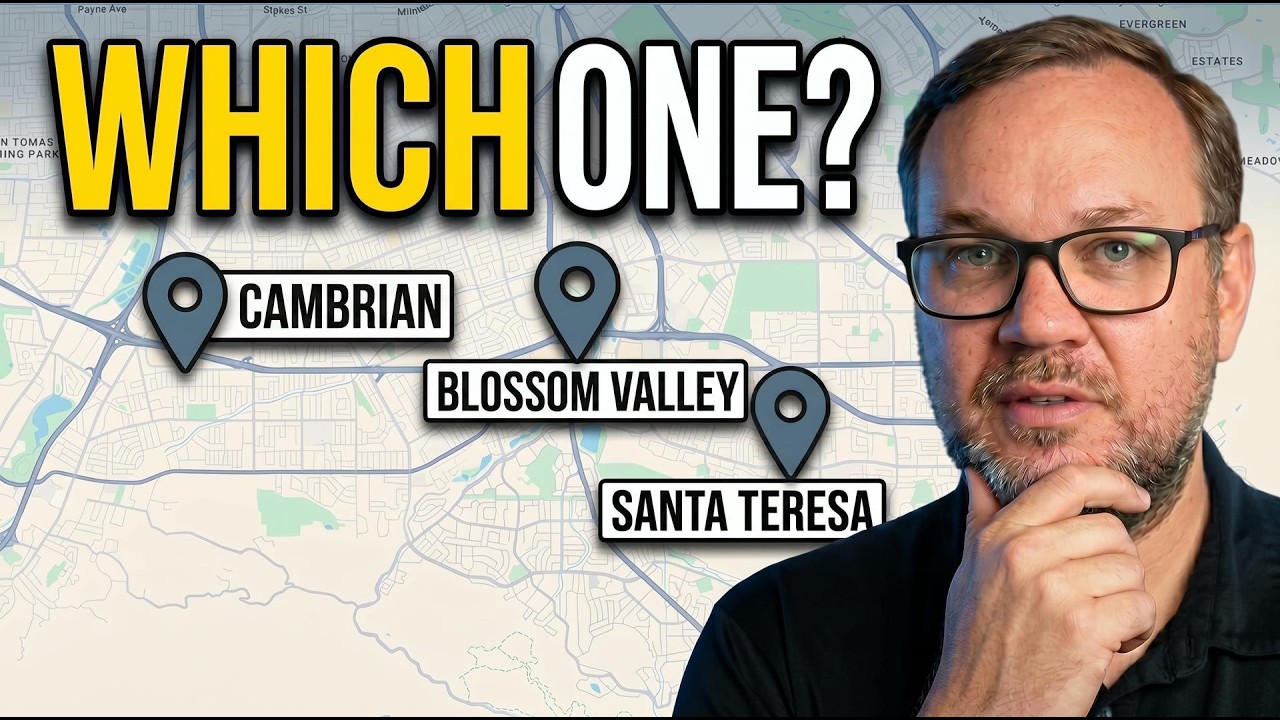
The short answer: Cambrian vs Blossom Valley vs Santa Teresa comes down to what you want next to your house. As of May 2026, Blossom Valley gave you the most house per dollar, Santa Teresa gave you the foothills and was the only one of the three that gained value over the prior year, and Cambrian cost about $350,000 more because it sits next to Campbell and the West Valley. Pick the one that matches your commute and your weekends, then your budget.
A lot of buyers treat South San Jose like one big interchangeable suburb. If you’ve seen one ranch house off 85, you’ve seen them all, so buy whatever fits the budget and move on. That read costs people real money in both directions.
I grew up in Almaden, right next to all three of these neighborhoods, and went to Leland High School. My family has been in the valley since before it was Silicon Valley, and I’ve spent weekends in Cambrian, Blossom Valley, and Santa Teresa my whole life. They share the same freeways and similar commutes. They are still three different places to live, and here is how I’d compare them in five rounds.
I walked through all five rounds on camera in June 2026.
Cambrian vs Blossom Valley: Which One Costs More?
Price frames everything else, so it goes first. In May 2026, the citywide San Jose single-family median was running right around $1.5 million. These three split around that line, and the split is bigger than most people expect.
| May 2026 | Cambrian | Santa Teresa | Blossom Valley |
|---|---|---|---|
| Single-family median | $1,850,000 | $1,527,500 | $1,500,000 |
| Price per square foot | $1,160 | $920 | $847 |
| Typical home size sold | About 1,600 sq ft | In between | Nearly 1,800 sq ft |
| Median change over the prior year | Down about 12% | Up (the only gain of the three) | Not broken out |
| Sales in May 2026 | 55 | Tightest inventory | 17 |
Cambrian sits about $350,000 above the other two, and Santa Teresa and Blossom Valley are basically tied. I like to look at price per square foot because it strips out the size of the home. Even after that, the order stays the same. In Cambrian you pay the most per square foot and get the smallest homes. In Blossom Valley the typical home sold in May 2026 penciled out at nearly 1,800 square feet, about 200 more than in Cambrian, on a lower budget.
Round one goes to Blossom Valley on pure dollars per square foot.
Update, November 2026: The county has loosened since May. In September 2026, MLSListings data showed 1,223 single-family homes for sale in Santa Clara County, up 21.2% from a year earlier, with a median of $1.9 million (down 3.6%) and homes selling at 103% of list. Neighborhood numbers move more month to month than the county, so I’d pull fresh comps before writing an offer in any of these three.
Why Does Cambrian Cost More? The Commute
Here is the key to the whole comparison. The reason Cambrian costs the most has almost nothing to do with the houses. It has to do with what it sits next to.
Cambrian: you’re paying for adjacency
Cambrian borders Campbell and runs toward the edge of Los Gatos, with Highway 17 and 85 close by. You’re paying to sit next to the West Valley without paying West Valley prices. If your job is at one of the tech campuses to the west or up toward San Francisco, Cambrian’s spot near 17 and 85 wins.
Blossom Valley: freeways plus Caltrain at the edges
Blossom Valley runs on 85 and 87, and Caltrain touches its edges at the Capitol and Blossom Hill stations. Those stops are on Caltrain’s South County service, so check the schedule against your hours. For anyone working downtown or up the Peninsula corridor, it’s a real option most buyers here never price in.
Santa Teresa: the most ways out
Santa Teresa sits at the end of VTA’s Blue Line light rail (Baypointe to Santa Teresa), near the 85 and 101 junction, with the Caltrain corridor right there. Of the three, it has the most ways out in the most directions. If you have a South County job, a hybrid schedule, or a commute that changes week to week, Santa Teresa is the most flexible.
One thing to watch: SB 79, the state transit housing law, allows taller buildings near qualifying rail and bus rapid transit stops. The station areas in Santa Teresa and along the Caltrain line are the ones I’d keep an eye on as it rolls out. I covered what it means for owners in 6 changes reshaping South San Jose home values.
Update, November 2026: SB 79 took effect on July 1, 2026, a few weeks after I recorded this. Near light rail stations, the law now allows buildings from 55 to 85 feet depending on distance from the stop.
Round two is a tie. It goes to whichever one matches your actual drive.
What Is Each Neighborhood Like on a Saturday?
Forget the spreadsheet for a minute. This is the round I grew up living.
Santa Teresa is the outdoors one
It backs right up to Santa Teresa County Park, so you have real trails and open hills out the back gate, plus a golf course right there. There’s a major Kaiser medical campus on its edge, which matters more than most people think for everyday appointments and errands. If your ideal Saturday is a hike or nine holes before lunch, this is it. Personally, this is the one I use the most. I golf, and I take my dog hiking up there.
Blossom Valley is the convenience one
It’s built around Oakridge Mall, with The Plant shopping center a short drive north. Big box shopping, groceries, restaurants, and a Friday movie are all close. Martial Cottle Park sits in the middle of it, a huge county park with working farmland inside the city. The central freeway position means you’re not boxed in wherever you’re headed.
Cambrian is the “borrow the good stuff” one
You’re minutes from downtown Campbell, the Pruneyard, and the Los Gatos Creek Trail. You get a walkable downtown, a farmers market, restaurants, and a creekside run on a Sunday morning without living in Campbell or Los Gatos and paying for that ZIP code.
Round three goes to whichever weekend is actually yours.
Setting and Homes: What Will You Be Buying?
This is the part you feel the second you turn onto the street.
| Neighborhood | Setting | Typical home era | Worth Knowing |
|---|---|---|---|
| Santa Teresa | Foothills, some hill views, a touch warmer and drier | Mostly 1970s and 1980s | Newer homes, usually fewer surprises behind the walls |
| Blossom Valley | Flat valley floor, easy to bike | Mostly 1960s and 1970s tracts, newer pockets toward Communication Hill | Bigger, consistent floor plans and the lowest price per square foot |
| Cambrian | Mature trees, established lots, interior streets that aren’t cut-through routes | Mostly 1950s and 1960s ranch homes | Lots of original-condition homes and remodel upside |
Here’s a real buyer tip. In Cambrian, you price the era into your offer: original plumbing, older electrical panels, foundations built to a different code. None of it is a deal breaker. All of it belongs in your number.
The single biggest price swing inside any of these three isn’t the street. It’s remodeled versus original condition. I’ve seen that gap run well into six figures on otherwise similar homes. Buy the bones, not the staging.
Round four splits. Hill views and newer homes: Santa Teresa. Flat, roomy, most space: Blossom Valley. Mature streets and remodel upside: Cambrian.
Did Cambrian Prices Drop 12%?
This is the market question I get asked most. Cambrian’s median dropped about 12% over the year ending May 2026. Its price per square foot only slipped about 4% over the same stretch.
When the median falls that much more than price per square foot, it usually means smaller homes made up more of the sales that year. It doesn’t mean every house lost 12%. For a buyer, that’s not a fire sale. It’s a little more room to negotiate than a year earlier.
Cambrian is also the deepest market of the three, with 55 sales in May 2026 against Blossom Valley’s 17. More homes means more comps and an easier resale later. Blossom Valley was the opposite: thin inventory and the most competition, with homes selling around 105% of list. Santa Teresa was the only one of the three that gained over the prior year, and it had the tightest inventory, which favors sellers.
What I’d Do: My Verdict by What You Want
There’s no universal winner. There’s a right answer for your commute, your weekends, your setting, and your budget, usually in that order. Anyone who names one winner for everyone is selling you their inventory, not the truth.
- Blossom Valley if you want the most house for your money, flat streets, central shopping, and you can be patient in a thin market.
- Santa Teresa if you want the foothills, trails and golf out the back, newer homes, and the neighborhood that held its value best over the year ending May 2026.
- Cambrian if you want mature, tree-lined streets, a walkable downtown minutes away, and the easiest resale, as long as you’re fine paying the most per square foot to get in.
If I were buying in any of them right now, I’d run price per square foot on remodeled and original homes separately, budget for the era of the house, and drive the commute at the hour you’d actually drive it. If you’re still deciding between parts of the city, my picks for the best San Jose neighborhoods at $1M, $2M, and $3M lay out the bigger map.
Frequently Asked Questions
Is Cambrian more expensive than Blossom Valley?
Yes. In May 2026 the Cambrian single-family median was about $1,850,000 against about $1,500,000 in Blossom Valley, roughly $350,000 more. Cambrian also ran about $1,160 per square foot versus $847 in Blossom Valley. Most of that premium comes from Cambrian sitting next to Campbell, Los Gatos, and Highway 17.
Which South San Jose neighborhood gives you the most house for the money?
Blossom Valley. As of May 2026 it had the lowest price per square foot of the three at about $847, and the typical home sold that month was nearly 1,800 square feet. The tradeoff is a thin market, so you may need to wait for the right home.
Did home prices in Cambrian drop?
The Cambrian median fell about 12% over the year ending May 2026, but price per square foot only slipped about 4%. That gap usually means more small homes sold, not that every home lost 12%. It points to a bit more room to negotiate, not a fire sale.
Does Santa Teresa have light rail?
Yes. Santa Teresa is the southern end of VTA’s Blue Line light rail, which runs from Baypointe to Santa Teresa. It also sits near the 85 and 101 junction and the Caltrain corridor, which gives it the most commute options of the three.
Is there Caltrain service in Blossom Valley?
Caltrain’s Capitol and Blossom Hill stations sit at the edges of Blossom Valley. They’re on the South County part of the line, so check Caltrain’s current schedule against your work hours before you count on it.
How old are the homes in Cambrian, Blossom Valley, and Santa Teresa?
Cambrian is mostly 1950s and 1960s ranch homes. Blossom Valley is mostly 1960s and 1970s tracts with some newer pockets toward Communication Hill. Santa Teresa leans newer, mostly 1970s and 1980s. In the older homes, budget for plumbing, electrical panels, and foundations.
Which of the three held its value best?
Santa Teresa. It was the only one of the three with a gain over the year ending May 2026, and it had the tightest inventory. That favors sellers there and means buyers should expect competition for the best homes.
Trying to choose between these three?
Grab my free buyers guide, or text me at 408-504-0385 and tell me where you work and how you spend your weekends. I’ll tell you straight which of the three I’d look at first. Moving here from out of the area and need to sell where you are now? I’ll connect you with a top agent from my referral network.
Keep Reading
- Best Neighborhoods to Buy in San Jose at $1M, $2M, and $3M: my picks at three budgets, with dated prices.
- South San Jose Home Values: SB 79, light rail, and the other changes most owners haven’t noticed.
- Living in Almaden Valley: the neighborhood next door to all three, where I grew up.
- Buying a Home at 7 Percent: the five steps I’d follow at today’s rates.
- 5 Costly Mistakes Homebuyers Make: what I see buyers get wrong most often.
Neighborhood prices, price per square foot, sales counts, and year-over-year changes are from my own MLS review as of May 2026. County figures are MLSListings data for September 2026. Numbers change month to month and are not guaranteed. This is general information, not legal or tax advice.
Michael Rulfs, REALTOR® | Coldwell Banker Realty | DRE #01832571. Third-generation South Bay. Born here, raised here, still here. 408-504-0385 · michael.rulfs@CBRealty.com
