
 Facebook
 X
 Pinterest
 Copy Link
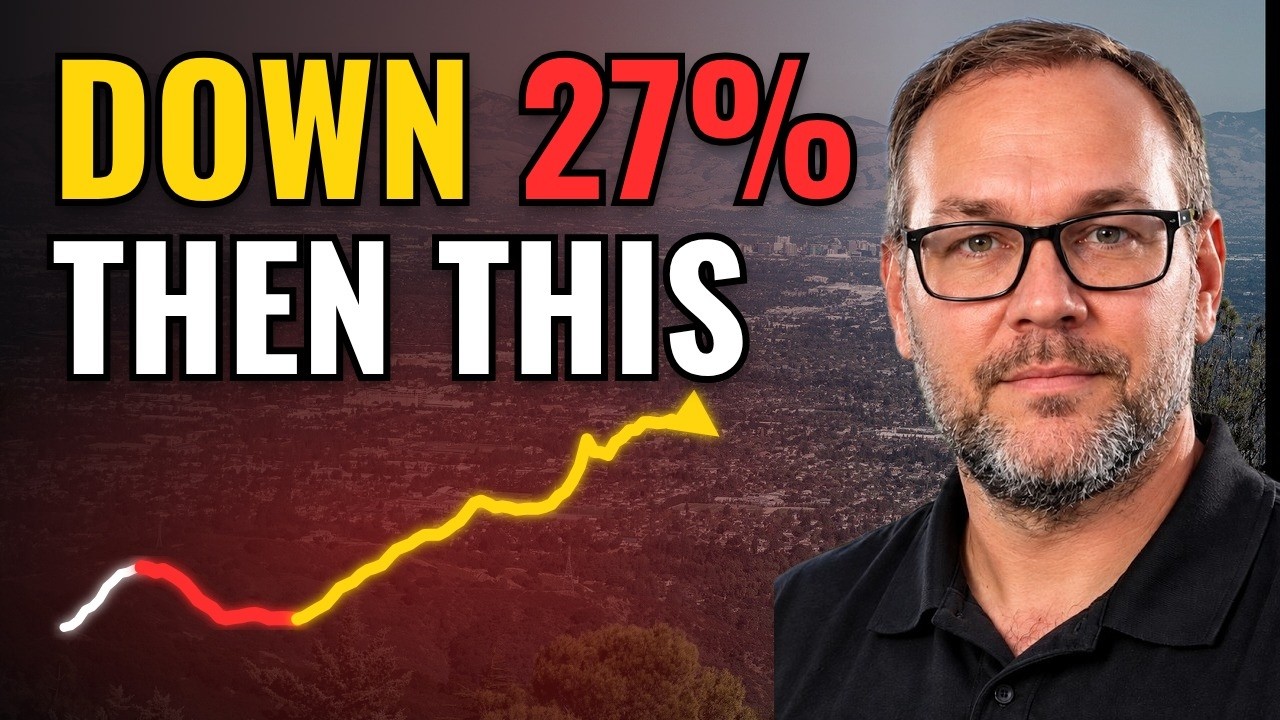
The short answer: I don’t expect a San Jose housing crash, meaning a 20% to 30% drop. As of October 2026 foreclosures are low and most owners have deep equity, so a small correction is far more likely. And in every Bay Area downturn since 1981, owners who held on got all of it back and then some.
After my last video on 7% rates, my comments filled up. A lot of people are feeling the pain of a 7% payment, and a lot of them are sure a San Jose housing crash is coming. Another 2008. Another dot com bust. One comment said agents are just cheerleaders. I’m not one. My job is to show you the numbers and tell you what I’d do with them.
I’m third-generation South Bay. I grew up in Almaden, went to Leland High School, and my family was here before this was Silicon Valley. I was in college during 2008, and I remember friends’ parents losing homes. It was scary. So I pulled the data on every downturn I could find and asked one question: what happened next?
I walked through all of these slides on camera in my October 3, 2026 livestream.
What counts as a San Jose housing crash?
Words matter here. A 4% or 5% dip is a correction. We’ve had a bit of a slowdown already. A crash, to me, is when prices fall 20% or 30%. That’s what 2008 was.
There’s also no rule that says we’re “overdue.” Housing and rates move in cycles, but there’s no science that says a crash comes every 20 years. You can watch the conditions that lead to one. You can’t put it on a calendar.
Why today doesn’t look like 2008
The 2008 crash had kindling. Lenders were handing out loans to almost anyone. Stated income loans let people buy homes they could never qualify for. When prices turned, millions of owners ended up underwater and had to sell.
Here’s what I see as of October 2026:
- Foreclosures: they’re up, but the figure I showed was about 55,000. Far fewer people are being forced to sell than in 2008.
- Underwater mortgages: the crisis-era figure was about 11.3 million. Getting back there would take a huge drop, because most owners today have a lot of equity.
- Cash: there’s a lot of it in this market. Cash buyers don’t get foreclosed on.
Could an outside shock change that? Sure. If the AI boom popped hard, that could hit this valley. But I don’t see the pieces lining up for a 2008 repeat right now.
Every Bay Area downturn since 1981, and what came after
This is the part I most want people to see. Every dip we’ve had, prices came back.
| Period | Bay Area price drop | What happened next |
|---|---|---|
| 1981 to 1983 | About 12% | By 1990 prices were well above the old high |
| 1989 to 1997 | About 12.5% (roughly 8 years) | Strong growth through the late 1990s and 2000s |
| 2001 to 2002 | About 4% | Prices accelerated again into the 2006 peak |
| 2006 to the 2008 crash | About 27% | Every dollar regained by 2015 |
| 2022, after rates rose | About 5% | Prices climbed past the 2022 high |
The 2008 drop was brutal. People watched their homes go underwater and felt like they were paying on dead money. But the ones who held on got every dollar back by 2015. The chart I showed put county prices about 75% above the 2006 peak as of 2026.
Most of these cycles were fully recovered within about 8 years. That’s why I tell buyers to plan on holding for at least 5. Real estate isn’t a short-term trade. If you want to hold something for a month, buy a stock.
What happens to mortgage rates in a housing crash?
History says they come down. The economy goes where the housing market goes, so when housing gets hit, rates have dropped. Here’s where rates sat around past turning points, using Freddie Mac’s mortgage rate survey:
| Year | 30-year fixed rate (annual average) | What was going on |
|---|---|---|
| 1981 | About 16% | Early 1980s downturn |
| 1990 | About 10% | Start of the 1990s slump |
| 2012 | 3.66% | Bottom of the 2008 housing crisis |
| 2021 | 2.96% | COVID-era low |
| Early October 2026 | 7.28% (the quote I showed) | Today’s 7% market |
Look at it next to the early 1980s and 7.28% isn’t that bad. The low rate of 2012 is what powered the comeback after 2008, and by 2015 prices were back above the old high.
As of early October 2026, the 10-year Treasury was over 5%. That usually isn’t a great sign. In my view, a lot of the current inflation comes from high oil prices, and the rest of the picture still looks solid: jobs, the stock market, and owner equity.
What 50 years of home values say
From the long-run data I showed:
- Home values grew about 30 times over 50 years. That works out to about 7% a year on average.
- That’s about 3.3% a year ahead of inflation.
- At 7% a year, a home takes about 10 years to double. In 15 of the 41 ten-year stretches, values did double.
- Zero of the 41 ten-year stretches ended lower.
Two more things most people miss. First, leverage. Buy a $2 million home with 20% down and your gain is on the full $2 million, not just the $400,000 you put in. Second, you’re paying the loan down every month while the home appreciates. It works like a forced savings account, the same way a 401(k) does.
And property taxes stay tied to what you paid. Taxes run about 1.2% of your purchase price. An owner who paid $100,000 decades ago in Cupertino pays far less than the person two doors down who just paid $3 million. You’ll always have taxes and upkeep. It still beats paying rent forever.
Can you afford San Jose on $280,000 a year?
One commenter said they earn $280,000 a year, save about 55%, and still can’t buy anything reasonable. I think they’re in a great spot. Here’s the math as of early October 2026:
| Item | Number | Notes |
|---|---|---|
| Household income | $280,000 a year | About $23,300 a month before taxes |
| Comfortable payment | About $6,500 to $8,400 a month | Roughly 28% to 36% of gross income |
| Price that fits | About $1,000,000 | At 7.28%, early October 2026 |
| Principal and interest, 20% down | About $5,470 a month | $800,000 loan, 30-year fixed |
| All in with tax and insurance | About $6,600 to $7,300 a month | 20% down vs 10% down, before any HOA |
About $1 million buys a condo, a townhome, or a starter home. It won’t buy a big single-family house in the most expensive neighborhoods. A lot of people who say they can’t afford to buy really mean they don’t want to start with a condo or a fixer. I get it. A million dollars is a ton of money. But the starter home is how you start building equity. My San Jose picks at $1M, $2M, and $3M show where that first tier lands.
Renting has real upsides. You’re flexible if your job might move you, and you don’t pay for repairs. But I like controlling where I live. If I want to redo my bathroom or put a hot tub in the backyard, I can. In an HOA you’ll have more rules, but it’s still yours.
What I’d do if a San Jose housing crash worries you
- Get a fixed rate. If rates fall after a downturn, you refinance. If they don’t, your payment stays put.
- Plan on five years, minimum. If you might leave in two, run the numbers on renting in that area first. Selling costs usually wipe out a short hold.
- Keep three to six months of reserves. We’re in Silicon Valley. Layoffs happen. I’ve been through one.
- Treat the pre-approval as a ceiling. It’s the most a lender says you can borrow, not a target. You can buy below it.
- Buy when the payment looks right. Look at the payment, not the rate. Even below your max, the first year will feel tight. After a year or two, it feels a lot better.
If you’re buying at 7% right now, my five steps for buying at 7 percent go deeper on rate buydowns and seller credits. You can also compare payments and loan types with the CFPB’s home buying tools, and track long-run price trends in the FHFA House Price Index.
Frequently asked questions
Is the San Jose housing market going to crash in 2026?
No one can predict that with certainty, and I don’t expect a crash. As of October 2026 foreclosures are low, most owners sit on a lot of equity, and there’s still cash in the market. A small correction of a few percent is possible. To me a crash is a drop of 20% to 30%, and I don’t see the conditions for that lining up right now.
How long did Bay Area home prices take to recover after 2008?
Prices fell about 27% in the 2008 downturn, and by 2015 they had gained every dollar back. Owners who held through it got their money back and then some. The ones who lost were mostly the ones forced to sell at the bottom.
How much did Bay Area home prices drop in past downturns?
In the data I showed, prices dropped about 12% from 1981 to 1983, about 12.5% from 1989 to 1997, about 4% in 2001 and 2002, about 27% around 2008, and about 5% after rates rose in 2022. Each time, prices later passed their old high.
What happens to mortgage rates if home prices crash?
In past downturns rates came down, because the housing market and the wider economy move together and policymakers respond. That’s why I like a fixed rate. If rates fall later, you can refinance. If they don’t, your payment never changes.
How long should I plan to own a home in San Jose?
Five years at a minimum, and ten is better. Selling inside five years usually means the selling costs eat your gain. In the 50-year data I showed, none of the 41 ten-year stretches ended lower.
Is $280,000 a year enough income to buy in San Jose?
It can be. At $280,000 a year a comfortable payment is roughly $6,500 to $8,400 a month, which points to about a $1 million purchase at an early October 2026 rate of 7.28%. That buys a condo, a townhome, or a starter house in parts of the county, not a large single-family home in the priciest areas.
Want to know what your market is actually doing?
Reach out anytime. Text me at 408-504-0385. I’m happy to just have a conversation, whether you’re moving to Silicon Valley, moving up, buying your first place, or want to know what your home is worth today.
Get my Buyers Guide · Moving to Silicon Valley? Start here · What’s my home worth?
Keep reading
- Silicon Valley home values: 5 forces repricing the market: why similar homes now sell for very different prices.
- Cheapest homes sold in Santa Clara County in October 2026: what priced-right homes did vs overpriced ones.
- 5 costly mistakes homebuyers make: the traps I see first-time buyers fall into.
- Contact me: questions about your home or your search.
Market figures, rates, and historical price changes come from the slides I showed on October 3, 2026 and are dated where they appear. Historical Bay Area price changes are approximate. Past performance doesn’t guarantee future results. This is general information, not financial or legal advice.
Michael Rulfs, REALTOR® | Coldwell Banker Realty | DRE #01832571. Third-generation South Bay. Born here, raised here, still here. 408-504-0385 · michael.rulfs@CBRealty.com
